Stepping Stone#
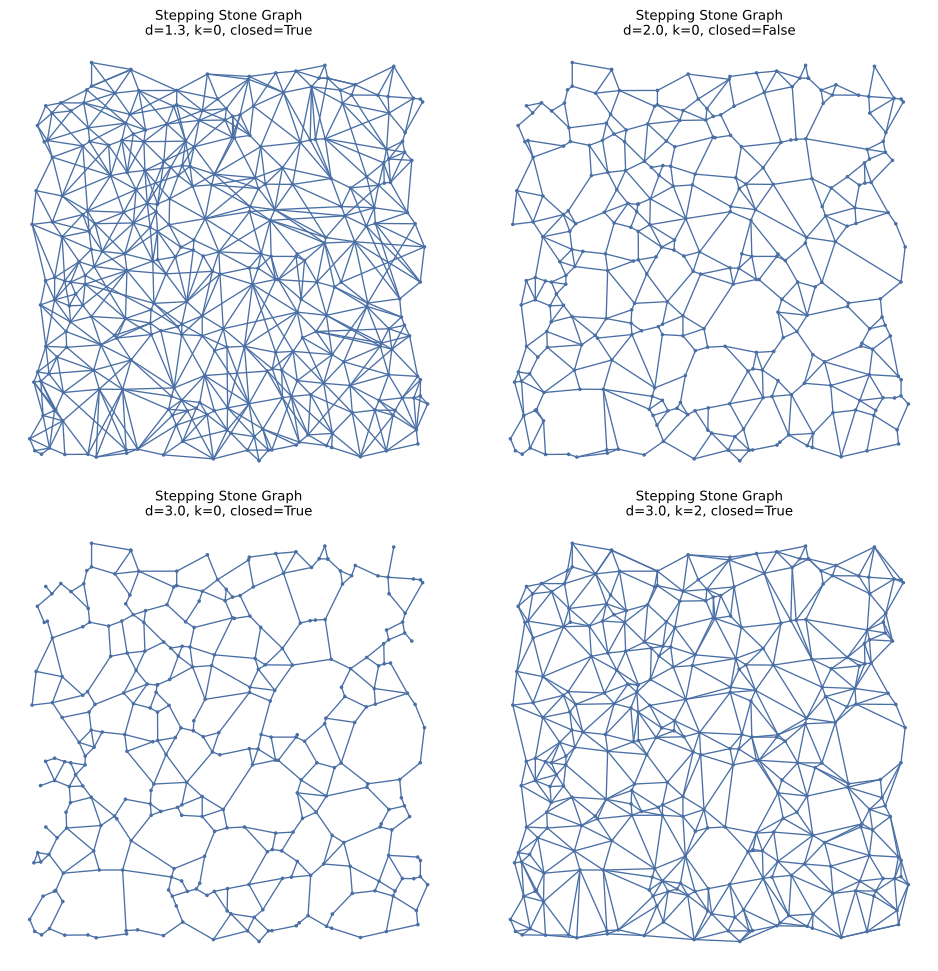
A d-diversion / stepping-stone proximity graph defined by d-neighborhood emptiness: two sites \(p,q\) are adjacent when a super-elliptic “lens” neighborhood around segment \(pq\) contains at most \(k\) other sites.
Constructor#
Stepping_Stone(setpoints, d=2, k=0, closed=True)
Parameters:
setpoints (SetPoints): The set of points \(P=\{p_1,\dots,p_n\}\subset\mathbb{R}^D\).
d (float): Shape exponent (must satisfy \(d\ge 1\)).
\(d=2\): the neighborhood equals the Gabriel diametral ball (see Special Cases).
Larger \(d\) yields a larger neighborhood, typically producing a sparser graph for fixed \(k\).
k (int): Allowed number of other sites inside the neighborhood (must satisfy \(k\ge 0\)).
closed (bool): If True, uses \(\le\) (closed neighborhood). If False, uses \(<\) (open neighborhood).
Mathematical Definition:#
Let \(P\subset\mathbb{R}^D\) with Euclidean norm \(\|\cdot\|\). For two distinct sites \(p,q\in P\), define the d-diversion neighborhood
Define the interior count
The stepping-stone graph is
Special Cases:#
\(d=2\) (Gabriel neighborhood): writing \(m=(p+q)/2\) and \(L=\|p-q\|\), the inequality \(\|x-p\|^2+\|x-q\|^2\le L^2\) is equivalent to \(\|x-m\|\le L/2\). Hence \(N_2(p,q)\) is the diametral ball with center \(m\) and radius \(L/2\), i.e. the Gabriel test region.
Limits:
\(d\to 1^+\): by the triangle inequality, \(\|x-p\|+\|x-q\|\le\|p-q\|\) forces \(x\) to lie essentially on the segment \([p,q]\) (degenerate “thin corridor”).
\(d\to\infty\): the condition approaches \(\max(\|x-p\|,\|x-q\|)\le \|p-q\|\), i.e. \(x\) lies in the intersection of the two radius-\(\|p-q\|\) balls centered at \(p\) and \(q\) (a lens).
Properties:#
Monotonicity in \(d\): for fixed \(p,q\), increasing \(d\) enlarges \(N_d(p,q)\), so the emptiness constraint is stricter; thus edges typically disappear as \(d\) increases (for fixed \(k\)).
Monotonicity in \(k\): increasing \(k\) relaxes the emptiness constraint; thus edges typically appear as \(k\) increases.
Containment for \(d\ge 2\): in fixed dimension, \(\ell_p\) norm monotonicity implies \(N_2(p,q)\subseteq N_d(p,q)\) for \(d\ge 2\). Consequently, when \(k=0\), \(\mathrm{SS}_{d,0}(P)\subseteq \mathrm{GG}(P)\) for \(d\ge 2\), and in nondegenerate 2D cases this is also a subgraph of the Delaunay triangulation.
Value Errors / Limitations:#
Raises
ValueErrorif \(d < 1\).Raises
ValueErrorif \(k < 0\).Raises
TypeErrorifkis not an integer.Raises
TypeErrorifclosedis not boolean.
Example#
import proximitygraphs as pg

pts = pg.SetPoints.uniform_square(n=300, seed=11)

G1 = pg.Stepping_Stone(pts, d=1.3, k=0, closed=True)
G2 = pg.Stepping_Stone(pts, d=2.0, k=0, closed=False)
G3 = pg.Stepping_Stone(pts, d=3.0, k=0, closed=True)
G4 = pg.Stepping_Stone(pts, d=3.0, k=2, closed=True)

graphs = [G1, G2, G3, G4]
pg.draw_grid(graphs, 2, 2, figsize=(10, 10), details=True)