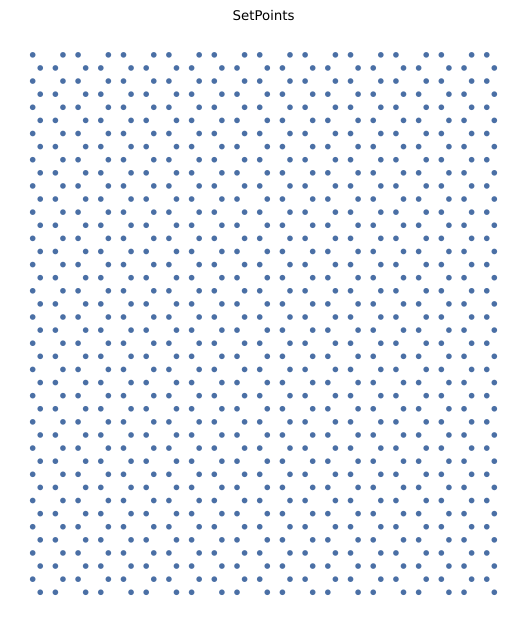
hexagonal#
Generates points forming a hexagonal lattice in a 2D plane.
A hexagonal lattice is constructed as the union of two interleaved grids. Points in a hexagonal grid are centers of hexagons in a tessellation, where each point has 6 equidistant neighbors.
The method generates two offset grids:
grid_1: Base grid with x-coordinates spaced by alternating increments (1, 2, 1, 2,…) and y-coordinates spaced by √3.
grid_2: Offset grid with x-coordinates shifted by -0.5 and y-coordinates shifted by 0.5√3.
The combination produces the characteristic hexagonal pattern.
Parameters#
n_x (int): Determines the extent of the hexagonal grid along the x-direction. Influences the number of columns.
n_y (int): Determines the extent of the hexagonal grid along the y-direction. Influences the number of rows.
Returns#
SetPoints: Instance with points forming a hexagonal lattice.
Example#
import proximitygraphs as pg

pts = pg.SetPoints.hexagonal(n_x=10, n_y=10)

pts.draw(figsize=(8, 8), v_color="#ff7f0e", v_size=18)