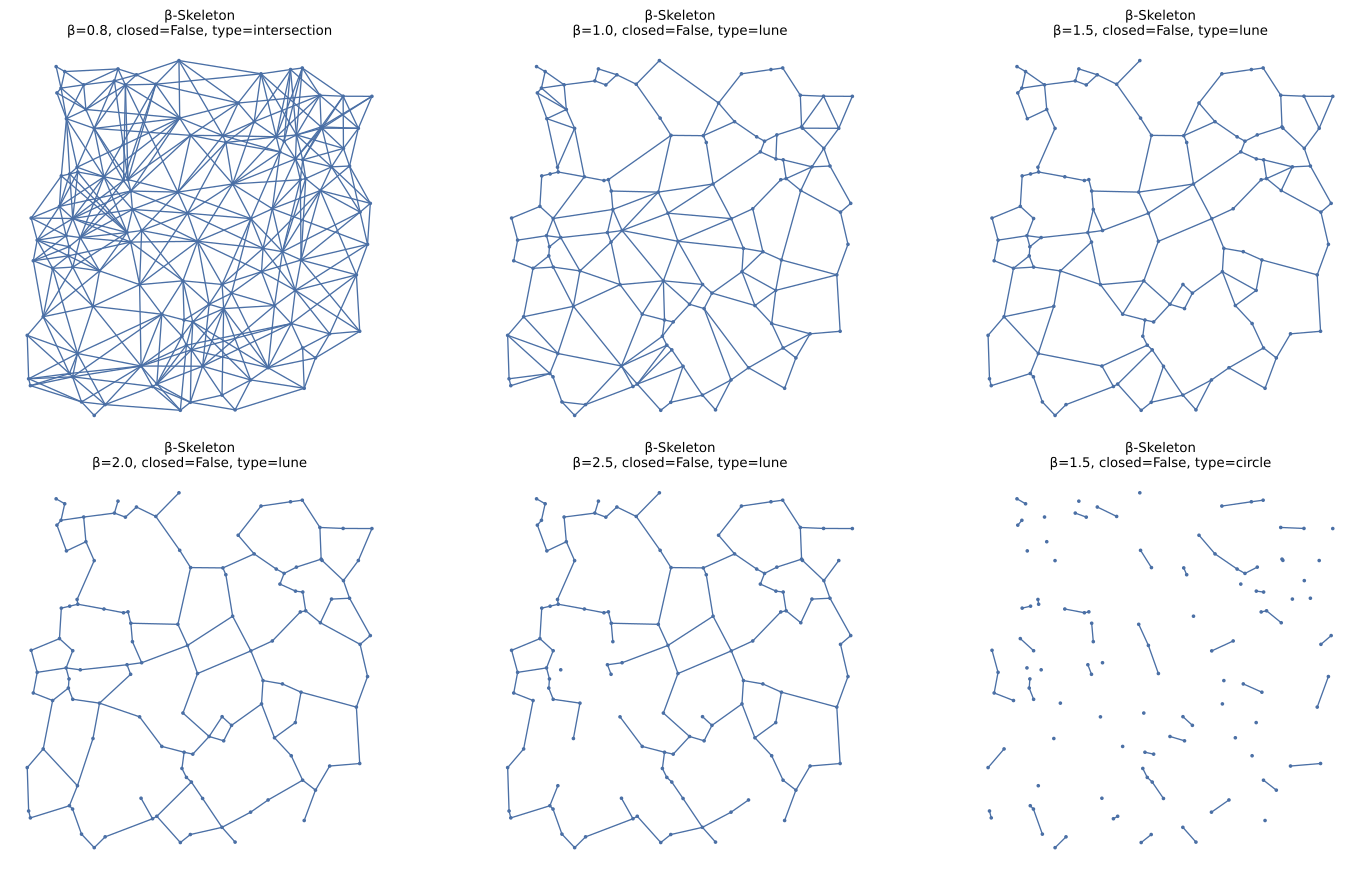
Beta Skeleton#
A parameterized family of proximity graphs where beta controls the neighborhood shape.
Constructor#
Beta_Skeleton(setpoints, beta=1.5, type_region="lune", closed=False)
Parameters:
setpoints (SetPoints): The set of points.
beta (float): The beta parameter (must be \(\beta > 0\)).
\(\beta < 1\): Intersection of circles (requires type_region=”intersection”)
\(\beta = 1\): Gabriel Graph (lune or circle)
\(1 < \beta < 2\): Intermediate lune-shaped regions
\(\beta = 2\): Relative Neighborhood Graph
\(\beta > 2\): Stricter than RNG
type_region (str): Region type:
“lune”: Lune-shaped region (default for \(\beta \geq 1\))
“circle”: Circular region (for \(\beta \geq 1\))
“intersection”: Intersection of circles (for \(\beta < 1\))
closed (bool): If True, uses \(\leq\) (closed region). If False, uses \(<\) (open region).
Mathematical Definition:#
For two points \(p, q \in P\), the edge \((p, q)\) is in \(\text{BS}_\beta(P)\) if the lune-shaped region \(L_\beta(p, q)\) contains no other points from \(P\).
Lune Region (\(\beta \geq 1\)):
where \(n\) is the unit normal to \(\overrightarrow{pq}\) and \(B(c, r)\) is a ball of radius \(r\) centered at \(c\).
Circle Region (\(\beta \geq 1\)):
Intersection Region (\(\beta < 1\)):
The edge \((p, q)\) exists if:
Special Cases:
\(\beta = 1, \text{lune}\): Gabriel Graph
\(\beta = 2, \text{lune}\): Relative Neighborhood Graph
\(\beta \to 0\): Approaches Delaunay triangulation
\(\beta \to \infty\): Approaches nearest neighbor graph
Value Errors:
Raises
ValueErrorif \(\beta \leq 0\)Raises
ValueErroriftype_regionnot in["lune", "circle", "intersection"]Raises
ValueErrorif \(\beta < 1\) andtype_region != "intersection"Raises
TypeErrorifclosedis not a boolean
Class Method: from_graph#
Beta_Skeleton.from_graph(geom_graph, beta=1.5, type_region="lune", closed=False)
Constructs a beta-skeleton using an existing graph’s edges as candidates.
Parameters:
geom_graph (GeometricGraph): Base graph providing edge candidates
beta (float): The beta parameter (must be \(> 0\))
type_region (str): Region type
closed (bool): Region closure
Returns:
Beta_Skeleton: A new beta-skeleton graph
Mathematical Definition:#
Given a graph \(G = (V, E)\), constructs \(\text{BS}_\beta(V)\) by testing only edges in \(E\) rather than all \(\binom{n}{2}\) pairs:
This is much faster when \(|E| \ll \binom{n}{2}\), such as when \(G\) is the Delaunay triangulation.
Value Errors:
Same as constructor
Raises
TypeErrorifgeom_graphis not aGeometricGraph
Example#
import proximitygraphs as pg

pts = pg.SetPoints.uniform_square(n=120, seed=42)

B08 = pg.Beta_Skeleton(pts, beta=0.8, type_region="intersection", closed=False)
B10 = pg.Beta_Skeleton(pts, beta=1.0, type_region="lune", closed=False)
B15 = pg.Beta_Skeleton(pts, beta=1.5, type_region="lune", closed=False)
B20 = pg.Beta_Skeleton(pts, beta=2.0, type_region="lune", closed=False)
B25 = pg.Beta_Skeleton(pts, beta=2.5, type_region="lune", closed=False)
B15c = pg.Beta_Skeleton(pts, beta=1.5, type_region="circle", closed=False)

graphs = [B08, B10, B15, B20, B25, B15c]
pg.draw_grid(graphs, 2, 3, figsize=(15, 9), details=True)