NNG (k-nearest neighbor graph)#
Connects each point to its k nearest neighbors.
Constructor#
NNG(setpoints, k=1)
Parameters:
setpoints (SetPoints): The set of points.
k (int): Number of nearest neighbors (must be \(1 \leq k < n\)).
Mathematical Definition:#
For each point \(p \in P\), let \(N_k(p)\) denote the \(k\) nearest neighbors of \(p\) (excluding \(p\) itself). The k-nearest neighbors graph is:
Note: This is typically a directed graph, but this implementation creates undirected edges (symmetric).
The distance to the k-th nearest neighbor of \(p\) is:
where \(B(p, r) = \{q \in P : \|q - p\| \leq r\}\).
Properties:
Always has at least \(kn/2\) edges (if symmetric)
Graph is typically connected for \(k \geq \log n\)
Can have up to \(kn\) directed edges
Useful for clustering and manifold learning
Can be computed in \(O(n \log n)\) using kd-trees
Value Errors:
Raises
ValueErrorif \(k < 1\) or \(k \geq n\)Raises
TypeErrorifkis not an integer
Example#
import proximitygraphs as pg

pts = pg.SetPoints.uniform_square(n=250, seed=42)

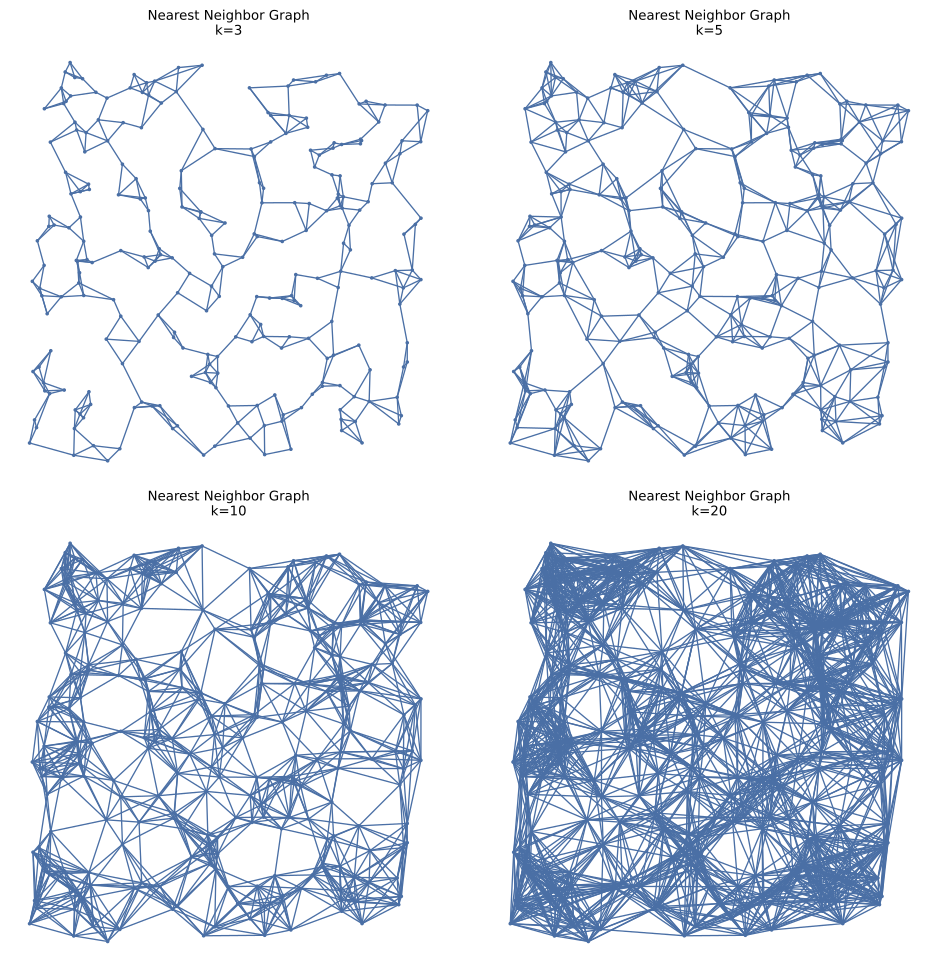
G3 = pg.NNG(pts, k=3)
G5 = pg.NNG(pts, k=5)
G10 = pg.NNG(pts, k=10)
G20 = pg.NNG(pts, k=20)

graphs = [G3, G5, G10, G20]
pg.draw_grid(graphs, 2, 2, figsize=(10, 10), details=True)