poissonprocess_square#
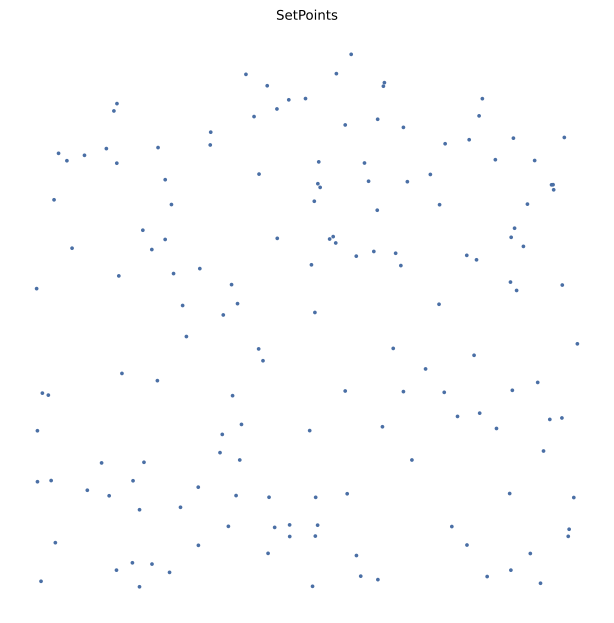
Generates points according to a homogeneous Poisson point process in a square region.
A 2D homogeneous Poisson point process is characterized by a constant intensity lambda (lambda), representing the average number of points per unit area.
The generation process involves two steps:
The number of points N is drawn from a Poisson distribution with mean L = intensity × area, where area = limit².
Given N points, their coordinates are drawn independently from uniform distributions U(0, limit) for both x and y.
This results in points randomly and uniformly distributed within [0, limit]².
Parameters#
intensity (float): The intensity (lambda) of the Poisson process, representing the average number of points per unit area. Must be positive.
limit (float): The side length of the square simulation window [0, limit]². Must be positive.
seed (int, optional): A seed for the random number generator to ensure reproducibility. If None, uses entropy from the OS.
Returns#
SetPoints: Instance with points following a Poisson process in the square.
Example#
import proximitygraphs as pg

pts = pg.SetPoints.poissonprocess_square(intensity=150, limit=1, seed=7)

pts.draw(figsize=(8, 8), v_color="#17becf")