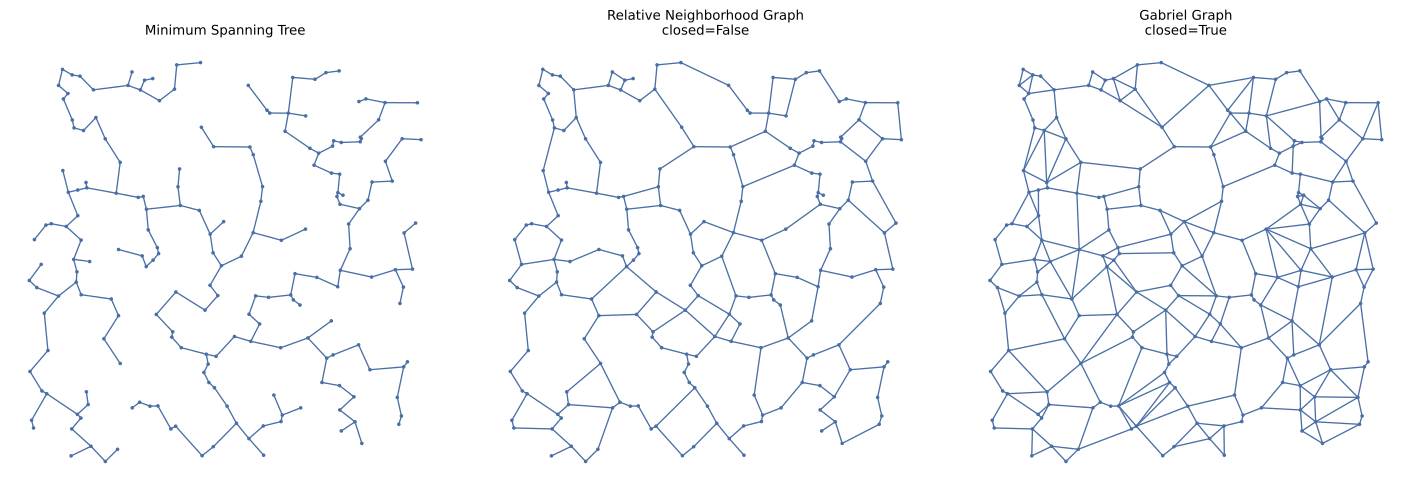
Relative Neighborhood Graph (RNG)#
The RNG is a beta-skeleton with beta=2.
Two points p and q are connected if the lune-shaped region between them contains no other points.
Constructor#
RNG(setpoints, closed=False)
Parameters:
setpoints (SetPoints): The set of points.
closed (bool): If False (default), uses \(<\). If True, uses \(\leq\).
Mathematical Definition:#
The Relative Neighborhood Graph \(\text{RNG}(P)\) contains edge \((p, q)\) if and only if:
Equivalently, the lune-shaped region \(L(p, q) = B(p, \|p-q\|) \cap B(q, \|p-q\|)\) is empty:
Geometrically, no point is closer to both \(p\) and \(q\) than they are to each other.
Properties:
Subgraph of Gabriel Graph: \(\text{RNG}(P) \subseteq \text{GG}(P)\)
Supergraph of MST: \(\text{MST}(P) \subseteq \text{RNG}(P)\)
Contains all nearest neighbor edges
Typically has \(O(n)\) edges
Graph is connected if MST is unique
Maximum degree is \(\leq 6n^{2/3}\) in 2D
Value Errors:
Raises
TypeErrorifclosedis not booleanRequires at least 2 points
Example#
import proximitygraphs as pg

pts = pg.SetPoints.uniform_square(n=200, seed=42)

G_mst = pg.MST(pts)
G_rng = pg.RNG(pts, closed=False)
G_gg = pg.GG(pts, closed=True)

graphs = [G_mst, G_rng, G_gg]

pg.draw_grid(graphs, 1, 3, figsize=(15, 5), details=True)