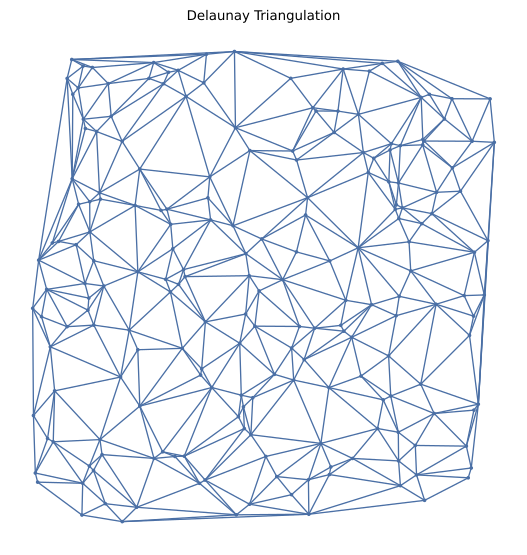
Delaunay Triangulation#
Constructs the Delaunay triangulation of a point set.
The Delaunay triangulation DT(P) has the “empty circle” property: no point in P is inside the circumcircle of any triangle.
Constructor#
DelaunayG(setpoints)
Parameters:
setpoints (SetPoints): The set of points to triangulate (must be in \(\mathbb{R}^d\) where \(d \geq 2\)).
Mathematical Definition:#
For a set of points \(P = \{p_1, p_2, \ldots, p_n\} \subset \mathbb{R}^d\), the Delaunay triangulation \(\text{DT}(P)\) is a triangulation where for every simplex \(S \in \text{DT}(P)\):
This is the “empty circumsphere” property. For each triangle with vertices \((p_i, p_j, p_k)\), the circumcircle \(C(p_i, p_j, p_k)\) satisfies:
where \(c\) is the circumcenter and \(r\) is the circumradius.
Properties:
Maximizes the minimum angle of all triangles (among all triangulations)
Unique for points in general position (no four points are cocircular)
Dual of the Voronoi diagram
Contains exactly \(\binom{n}{2}\) edges for \(n\) points in convex position
Value Errors:
Raises
ValueErrorif fewer than \(d + 1\) points are provided (minimum for a simplex in dimension \(d\))Raises
QhullErrorif points are degenerate (e.g., all collinear in 2D)
Example#
import proximitygraphs as pg

pts = pg.SetPoints.uniform_square(n=200, seed=42)

G = pg.DelaunayG(pts)
G.draw(figsize=(7, 7), details=True)