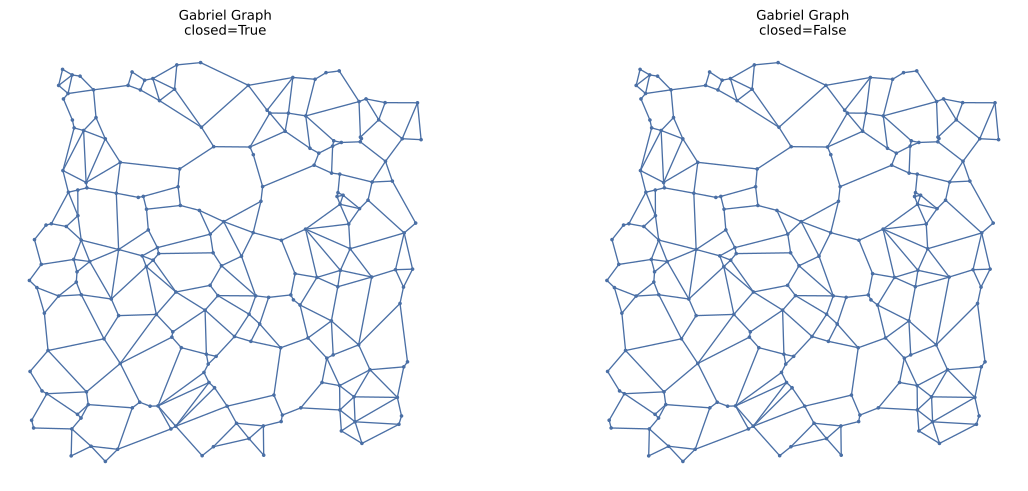
Gabriel Graph#
The Gabriel Graph is a beta-skeleton with beta=1.
Two points p and q are connected if the circle with diameter pq contains no other points.
Constructor#
GG(setpoints, closed=True)
Parameters:
setpoints (SetPoints): The set of points.
closed (bool): If True (default), uses \(\leq\). If False, uses \(<\).
Mathematical Definition:#
The Gabriel Graph \(\text{GG}(P)\) contains edge \((p, q)\) if and only if the closed ball with diameter \(\overline{pq}\) is empty:
Equivalently, \((p, q) \in \text{GG}(P)\) if:
This is the “empty diametral circle” property.
Properties:
Subgraph of the Delaunay triangulation: \(\text{GG}(P) \subseteq \text{DT}(P)\)
Supergraph of RNG and MST: \(\text{MST}(P) \subseteq \text{RNG}(P) \subseteq \text{GG}(P)\)
Important in wireless sensor networks (models direct communication)
Typically has \(O(n)\) edges
Can be computed in \(O(n \log n)\) time via Delaunay
Value Errors:
Raises
TypeErrorifclosedis not booleanRequires at least 2 points
Example#
import proximitygraphs as pg

pts = pg.SetPoints.uniform_square(n=200, seed=42)

G_closed = pg.GG(pts, closed=True)
G_open = pg.GG(pts, closed=False)

graphs = [G_closed, G_open]
pg.draw_grid(graphs, 1, 2, figsize=(12, 5), details=True)